




Is window cleaning with drones the new normal?

Is window cleaning with drones the new normal?
Every few months, a video makes the rounds: a drone hovering forty feet off a glass tower, spraying water, no crew in sight. The comments fill up with the same reaction — so this is how it's done now? It's a fair question. Drone window cleaning is real, it's growing fast, and the marketing around it is confident. But "the new normal" is a high bar, and the honest answer is more interesting than either the hype or the skepticism.
We've watched this technology mature, and we think it's genuinely useful — for the right buildings, in the right conditions. Here's a clear-eyed look at where drones actually fit.
How drone window cleaning works
A window-cleaning drone is a heavy-lift UAV fitted with spray nozzles, fed by a hose that runs from a ground-based pump and purified-water supply. Instead of ropes and lifts, the drone hovers near the glass while a technician controls the system from the ground, and purified water is delivered through lightweight hoses to remove dirt without leaving streaks.
The cleaning method is "soft washing" — low-pressure deionized water rather than scrubbing. This soft-wash approach removes grime from glass and facades without damaging delicate seals, coatings, or masonry, while LiDAR and ultrasonic sensors keep the drone a precise, safe distance from the building to prevent collisions. The water is purified — typically through reverse osmosis and deionization — so it dries spot-free without anyone needing to squeegee.
If that sounds familiar, it should: it's the same principle behind water-fed pole cleaning, just delivered from the air instead of from the ground.
What drones genuinely do well
The case for drones is strongest on a few specific points, and they're worth taking seriously.
Safety. This is the headline benefit, and it's real. Falls are one of the leading causes of workplace fatalities in construction and building maintenance, and drone cleaning removes the need for workers to leave the ground, drastically reducing the risk of injury. Fewer people at height means lower liability and, often, lower insurance exposure for the building owner.
Speed and setup. No scaffolding to erect, no swing stage to rig, no street-level staging area tied up for days. The result is faster setup, fewer crew members, and minimal setup space — especially valuable in busy urban environments. PSI
Reaching awkward geometry without anchors. This is the one that matters most for modern towers. Drone cleaning lets buildings with zero or limited roof anchors maintain clean windows without installing anchors or complex rigging, reaching high-rise exteriors, overhangs, false balconies, and intricate architectural details — including portions of a building that have gaps in coverage from traditional roof-based access.
Where drones fall short
Here's the part the marketing videos skip — and the part that matters most when you're deciding how to maintain an actual building.
Height limits. Drones don't go as high as the towers that most need cleaning. The hose-fed systems on the market are generally rated to around 120 meters (roughly 400 feet), and projects above that are reviewed case by case. One leading 2026 facade-cleaning drone system supports projects up to 120m, with anything above reviewed individually. For a true high-rise — the kind we specialize in — a drone often can't reach the top third of the building.
Wind and weather. A drone is a lightweight object hovering near a hard surface in the exact place where wind is most unpredictable: the face of a tall building, where gusts funnel and swirl. Manufacturers build in failsafes — but the operational window is narrower than for a crew on a fixed rope or a stable platform.
It's a rinse, not a detail. Soft washing is excellent for routine dirt and maintaining already-clean glass. It is not the tool for hard-water mineral scale, construction debris, adhesive residue, or the kind of restoration work that needs a hand, a blade, and cerium oxide. A drone can keep clean glass clean. It generally can't restore neglected glass.
Regulation. Drone cleaning is aviation. FAA Part 107 licensed operators are required for compliance with aviation and safety regulations. Flight near tall buildings, in dense urban areas, or near airports introduces permitting and airspace constraints that rope access and swing stage simply don't have.
So — the new normal?
Not quite. A more accurate way to put it: drones are becoming a permanent option, not a universal replacement.
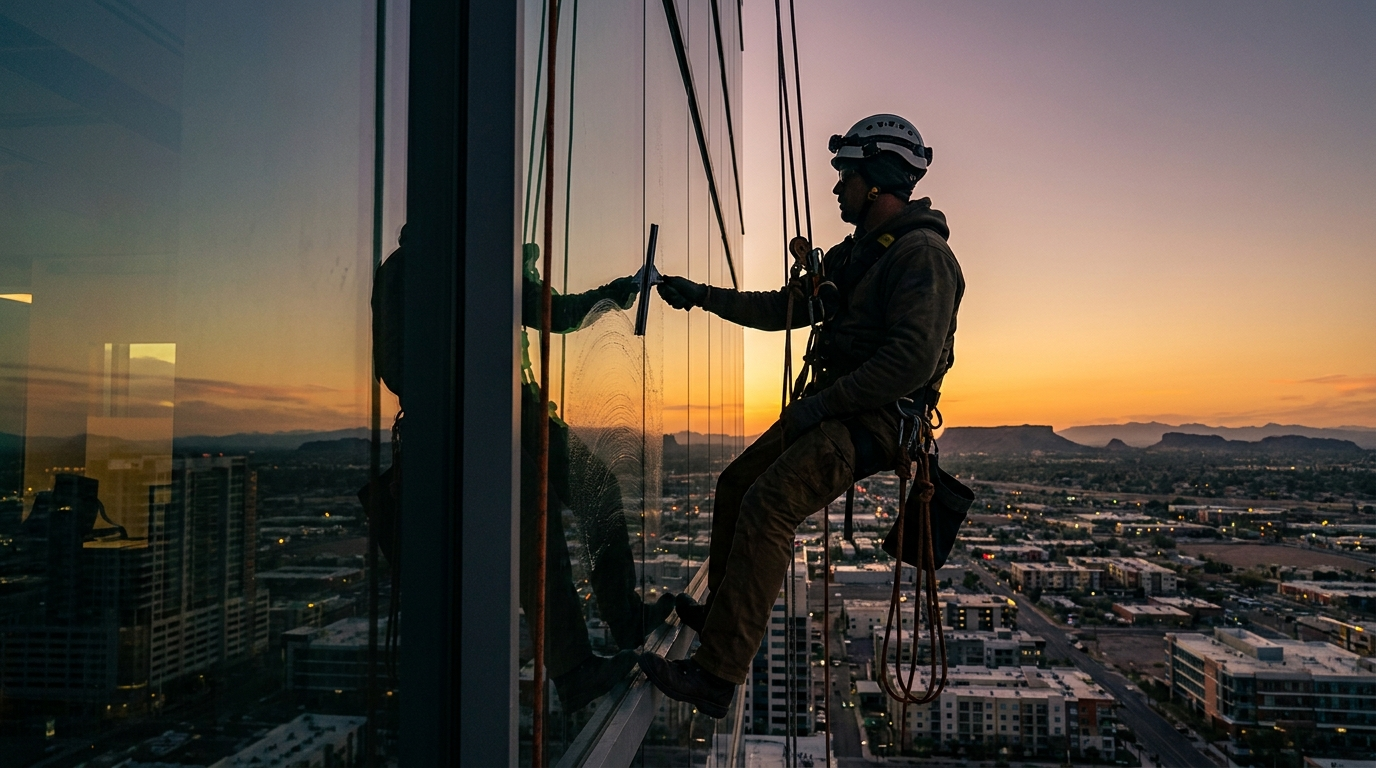
For a mid-rise building with awkward architecture, no roof anchors, and routine cleaning needs, a drone can be the smartest tool available. For a 40-story tower that needs its top floors reached, its hard-water scale removed, and its facade restored, a drone is one tool in a kit that still needs rope access, swing stage, and skilled hands.
This is the same thing we say about every method: the building decides. There's no single best way to clean high-rise glass — there's only the right method for a specific facade, in specific conditions, for a specific result. Drones expand the toolkit. They don't replace the judgment of choosing the right tool.
If someone tells you drones are the only future of window cleaning, they're selling drones. If someone tells you they're a gimmick, they haven't watched one work. The truth, as usual, is in the middle — and it depends entirely on your building.
That's the conversation we have on every site walk: not "what method do we prefer," but "what does this building actually need." Sometimes, increasingly, the answer involves a drone.